Articles of Historical Value
Fri March 4th, 2005
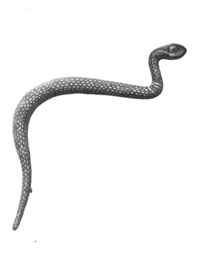
2 Kings 18:4 He removed the high places, smashed the sacred stones and cut down the Asherah poles. He broke into pieces the bronze snake Moses had made, for up to that time the Israelites had been burning incense to it. (It was called Nehushtan) 5 Hezekiah trusted in the LORD, the God of Israel. There was no one like him among all the kings of Judah, either before him or after him. 6 He held fast to the LORD and did not cease to follow him; he kept the commands the LORD had given Moses. NIV
Hezekiah is remembered for being a good King of Judah. 2nd Kings makes a remarkable note about his life when it says that he destroyed the bronze snake that Moses had made.
Over 700 years before Hezekiah was born, the Israelites in the desert had rebelled against Moses and God and venomous snakes had infested the camp killing many. When they cried out to God, He gave a solution.
Num 21:8 The LORD said to Moses, "Make a snake and put it up on a pole; anyone who is bitten can look at it and live." 9 So Moses made a bronze snake and put it up on a pole. Then when anyone was bitten by a snake and looked at the bronze snake, he lived. NIV
Without doubt, to the dying the sight of that bronze snake was fantastic – it meant life and they were grateful for it. Also this represented a 'type' or symbol of Jesus on the cross, because Jesus himself said that:
John 3:14 Just as Moses lifted up the snake in the desert, so the Son of Man must be lifted up, 15 that everyone who believes in him may have eternal life. NIVJohn 12:32 But I, when I am lifted up from the earth, will draw all men to myself." 33 He said this to show the kind of death he was going to die. NIV
However, over the years, instead of being grateful to God who provided healing they began to worship the metal snake instead. The symbol became their focal point rather than God who was their source of life.
You may think this is bizarre, but actually we are still like this today. In some of our churches the presence of God is either long gone or barely with us, and still we worship the structure and methods which our father's used. Instead of continually reaching out to God and receiving fresh blessing, direction and refreshing, we 'do church'.
It may be that D L Moody once preached here or Smith Wigglesworth or Reinhard Bonnke. Maybe revival fell here in 1932, but what is God saying now?
When Martin Luther nailed up his 95 theses, it was a day when men stood between other men and God as intermediaries. We were expected to approach the priest rather than God. Yet today, there are still thousands of Christians who wait to hear what the Pastor has to say rather the seek God for themselves. This is not to devalue preaching, but we were designed to hear God ourselves.
All the way back in the days of Moses, God called all the people up to hear His voice, but Moses says:
Deut 5:5 At that time I stood between the LORD and you to declare to you the word of the LORD, because you were afraid of the fire and did not go up the mountain NIV
God is still waiting for us to draw near!
Nehushtan which means 'bronze serpent' sounds like the Hebrew for 'unclean thing'. How could the Jews worship an unclean thing for 700 years? The bronze snake represented an experience rather than the God of the experience.
Today we have people who shake, leap, shout and fall over in the presence of God. People go out of our meetings on great 'highs'. But we must not worship the 'highs' or the experience. It is not the supernatural that we should focus on but the God of the supernatural.
I enjoy these fantastic times in God's presence too – but they do give us a great feeling, which our bodies enjoy. We must be careful that we don't fall into the trap of seeking these experiences because we feel better afterwards.
1 Cor 14:26 What then, brethren, is [the right course]? When you meet together, each one has a hymn, a teaching, a disclosure of special knowledge or information, an utterance in a [strange] tongue, or an interpretation of it. [But] let everything be constructive and edifying and for the good of all. AMP
Everything we do should be for the edifying or building up of others – not for ourselves; otherwise we begin to act selfishly and in doing so ignore the Lord's body and the Lord Himself.
2Kings 18:5&6 tell us the sort of man that Hezekiah was. He did not cease to follow the Lord. It is easy to cease following the Lord, all you have to do is stop listening and carry on in the direction the Lord was going. As soon as the Lord changes direction you are left following Nehushtan.
At the Ark it is our commitment that we will not do things because that is the way they have always been done. Neither will we seek to duplicate some of the fantastic highs we have had in our meetings together. We will not be constrained by the legitimacy of previous experience; instead we will progress in our relationship with God, who has deposited His Spirit within us.
In fact if we find any bronze snakes lying around, we will smash them like Hezekiah did, whether they have historical significance, artistic value or just sentimental attachment.